

Portfolio Project
Dynamic Localization and Synchronization of Distributed Camera Networks
A two-node Raspberry Pi camera testbed exploring UWB and IMU sensor fusion for pose initialization, spatially aware capture, and offline alignment of distributed camera streams.
Krutik Pandya · Rice University · ELEC 537 final project · December 2025
Skills
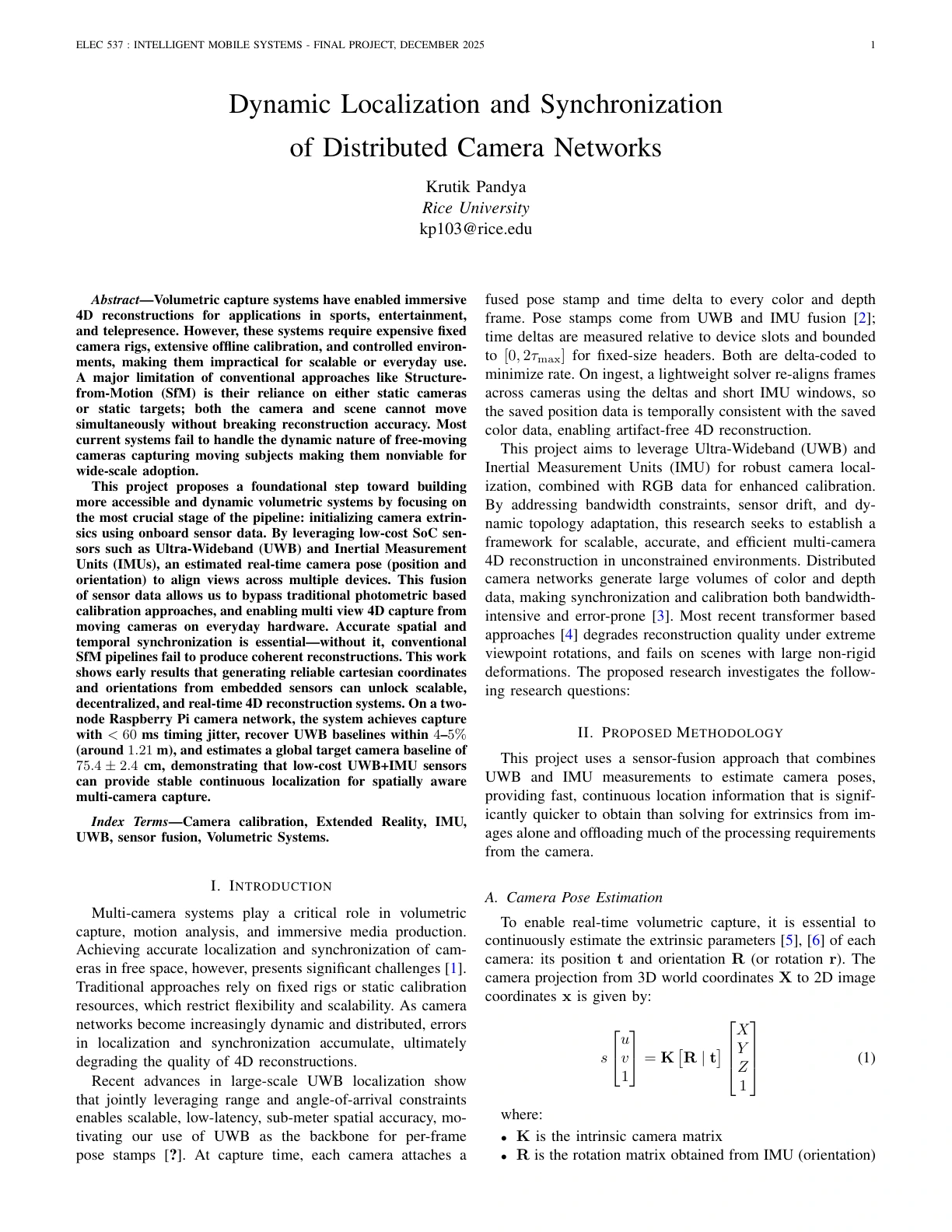
Read the paper
Browse all 6 pages, zoom in, or expand the preview.
Overview
A two-node Raspberry Pi camera testbed exploring UWB and IMU sensor fusion for pose initialization, spatially aware capture, and offline alignment of distributed camera streams.
From sensor measurements to camera poses
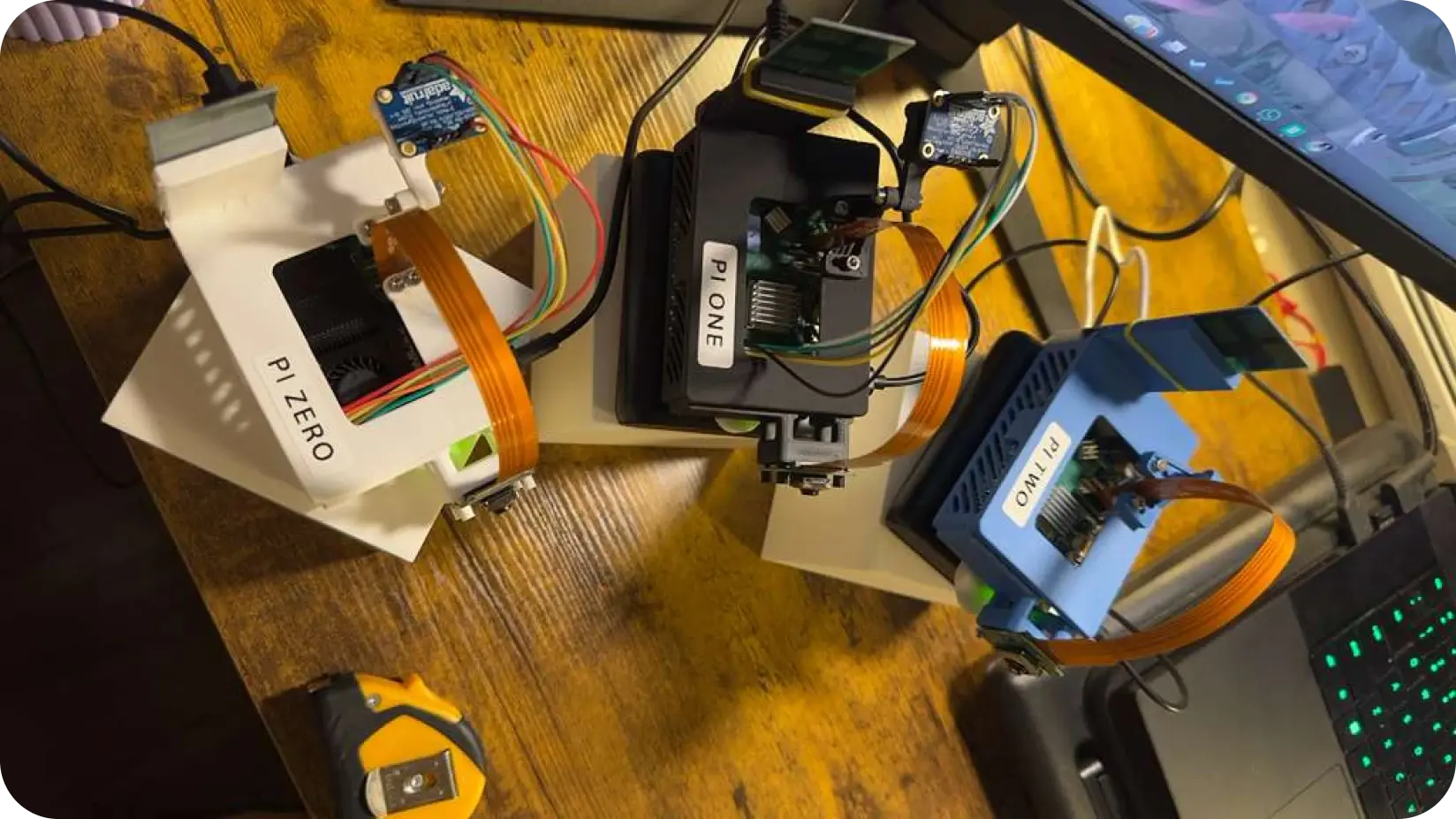
Each capture node combines a Raspberry Pi 5, Pi Camera Module 3, BNO055 IMU, and NXP UWB module. A Python logging stack records RGB frames, orientation, and ranging data with timestamps. A separate host aligns the logs and estimates relative geometry, exploring how low-cost sensors can initialize camera poses for multi-view capture.
The report also describes a keyframe-selection policy that uses changes in UWB baseline and IMU orientation to identify spatially informative views and reduce redundant frames.
Two-node prototype results
- Measured capture rate
- 0.91–0.92 fps
- 103 and 104 frames over approximately 112 seconds; inter-frame interval standard deviation of 47–55 ms.
- Static UWB baseline
- 121.0–121.2 cm
- Mean range in the filtered static subset (81 samples per node); standard deviation of 5.38–5.72 cm.
- Estimated target-to-Pi baseline
- 75.4 ± 2.36 cm
- Mean ± standard deviation across valid global-coordinate estimates; observed range of 71–80 cm.
Scope and next steps
These experiments cover two nodes and static or slowly moving tabletop scenes. Capture jitter measures each node's frame intervals, not cross-camera synchronization accuracy: residual clock offsets remained on the order of seconds, and frames were paired offline using nearest timestamps. Spatial-event synchronization, larger networks, higher frame rates, and full dynamic 4D reconstruction integration remain future work.